Answer-first summary
For most collectors, the best entry point is a simple two-tier system: place ordinary cards in correctly sized, non-PVC sleeves inside supportive boxes, and give selected raw cards an inner sleeve, a correctly fitted top loader, and an optional resealable outer bag. Add ringless binders for coherent sets, semi-rigid holders for an active grading queue, slab boxes for graded cards, and security only when those needs actually exist.
The best starting point is a two-tier storage system
The best entry point into sports card storage is not a safe, a wall of display cases, or a premium holder for every card. It is a modest system that gives ordinary cards appropriate support and gives selected cards extra rigidity. For most collectors, that means non-PVC sleeves and fitted card boxes for the main collection, plus sleeves, correctly sized top loaders, and optional resealable outer bags for cards that deserve individual protection.
This starting point works because it addresses the common risks first: direct handling, surface contact, bending, sliding, dust, and disorganized stacking. It is inexpensive enough to apply consistently and standardized enough to remain useful when the collection grows. A collector can later add binders, semi-rigid holders, slab boxes, portable cases, magnetic holders, or a safe without discarding the foundation.
The important word is fitted. A familiar product name does not guarantee a safe result. Cards vary in thickness, and holders vary in internal depth. Boxes designed for bare cards may not accept top loaders. Binder pockets may be too tight for sleeved cards. The smartest first purchase is therefore a small test quantity representing the actual collection, followed by a larger order only after the fit is confirmed.
Collectors who want a broader preservation framework can use the complete sports card storage guide. This article focuses specifically on the order in which storage purchases begin to make sense.
How we ranked the entry points
An entry point should solve a common problem without creating several new ones. We considered six questions.
- How much risk does it remove? Surface contact, bending, movement, water, light, theft, and transport are different problems.
- How many cards can it serve? A basic box may help thousands of cards, while a magnetic holder protects one.
- How sensitive is correct use? Some supplies are forgiving; others depend on exact thickness or installation.
- Will it scale? Standard dimensions and replaceable parts are easier to extend than proprietary systems.
- Can cards still be found? Protection loses practical value when a card disappears inside an unmarked container.
- What does it postpone? Good first purchases leave room for later grading, display, selling, or insurance decisions.
This is a ranking of buying sequence, not prestige. A card safe can be excellent for the right collection and still be a poor first purchase. A plain cardboard storage box can be the correct first purchase even though it has little visual appeal.
Entry point 1: safe sleeves and fitted card boxes
For a mixed collection of ordinary raw cards, sleeves and supportive boxes offer the widest benefit per unit of cost and space. Sleeves reduce direct contact and handling abrasion. A box keeps cards upright or otherwise properly supported, limits shifting, blocks routine light exposure, and creates an address that can be recorded in an inventory.
Choose sleeves whose material is clearly identified. The U.S. National Archives lists polyester, polypropylene, and polyethylene among stable plastic choices for photographs and papers and warns against unknown plastics and polyvinyl chloride. Sports cards are commercial printed objects rather than archival photographs, but the same conservative principle is useful: do not put a collectible in long-term direct contact with a plastic whose composition the seller will not disclose.
Fit matters at both levels. A sleeve should accept the card without force and should not leave so much room that the card repeatedly moves. The box should be large enough for the chosen sleeve or holder but not allow rows to collapse. Use smooth spacers when a row is partly filled. Do not overstuff the box, bow cards, or let corners project above dividers.
Start with one box, one package of sleeves, and several representative cards:
- a standard base card
- a glossy or chromium-finish card
- an older card with different dimensions
- a thick insert or memorabilia card
If one supply does not fit all four, that is useful information. Divide the collection by format instead of forcing every card into the same enclosure.
Best for: base cards, set-building inventory, duplicates, inherited collections awaiting review, and lower-consequence cards.
Why it ranks first: it creates broad protection and order without using excessive space or money.
Main limitation: a sleeve and box provide limited rigidity for an individually valuable or frequently handled card.
Entry point 2: sleeves, top loaders, and outer bags
Top loaders are the strongest general-purpose first upgrade. They add bending resistance while keeping the card visible, and their familiar dimensions work with many purpose-built boxes and shipping methods. An inner sleeve prevents the card surface from rubbing directly against the rigid plastic. A resealable outer bag can reduce dust, prevent accidental exit, and hold a removable inventory label.
Do not decide that every card needs a top loader. A large bulk collection becomes expensive, heavy, and inefficient when each low-consequence card receives rigid protection. Select cards according to replacement difficulty, condition sensitivity, handling frequency, personal importance, or a near-term plan such as trade, sale, or grading review.
Thickness is the main trap. Standard cards, chromium cards, memorabilia cards, and premium stock can require different holder depths. A card that catches at the opening or needs pressure is not correctly fitted. A card that rattles inside a deep holder may strike the edges when moved. Use manufacturer thickness guidance as a starting point, then test the exact card.
Store top loaders upright in a compatible box with enough space for controlled removal. Do not pack them so tightly that fingers pinch holder edges, and do not leave a row loose enough to fall repeatedly. Replace badly scratched or cracked holders; the enclosure should make condition easier to inspect, not obscure it.
Best for: selected raw singles, condition-sensitive cards, trade candidates, and cards handled more often than the bulk collection.
Why it ranks second: it adds meaningful rigidity while remaining affordable, recognizable, replaceable, and easy to inventory.
Main limitation: thickness mistakes, scratched holders, and unnecessary use can add cost and bulk.
Entry point 3: a ringless, side-loading binder
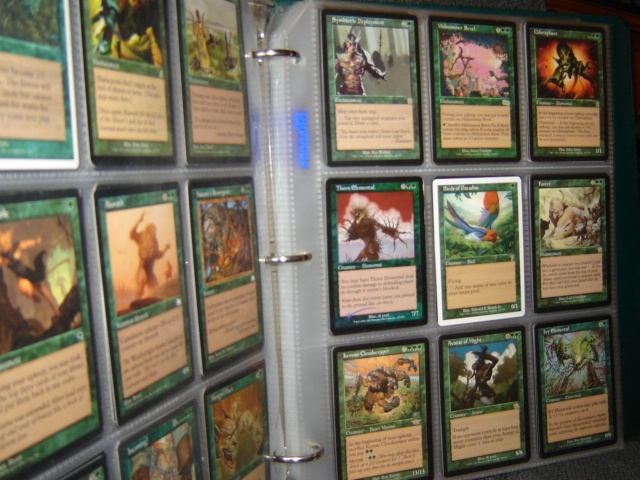
A binder is a sensible early purchase when the collection has a coherent visual structure: a complete set, a team run, a player collection, or a season project. Fixed, ringless pages avoid the risk of metal rings pressing into nearby cards. Side-loading pockets reduce the chance of cards sliding out when the binder is carried upright.
The binder should accept cards in the intended inner sleeves without pressure. Thick cards, patches, and some premium inserts do not belong in standard nine-pocket pages. A page that curls, stretches, or grips a card tightly is not a successful fit. Material specifications should be clear, and the binder should remain in a stable indoor location away from direct sunlight and damp surfaces.
Binders provide context that boxes cannot. A missing card is visible, variations can be compared on one spread, and the collection can be enjoyed without repeated individual removal. That makes a binder an excellent entry point for set-focused collecting, but not a universal replacement for boxes and rigid holders.
Give each binder a code and record page and pocket locations. If a card is removed, insert a neutral placeholder and update the inventory. Otherwise the strongest visual storage system can become a weak recordkeeping system.
Best for: sets, team collections, player runs, and lower- to moderate-consequence cards that benefit from visual sequence.
Why it ranks third: it combines organization, viewing, and reasonable handling protection for a defined type of collection.
Main limitation: it offers less individual rigidity and can damage cards when pockets are overfilled or poorly sized.
Entry point 4: a semi-rigid grading queue
Semi-rigid holders should enter the system when grading becomes a real workflow rather than a vague future possibility. They use less space than top loaders and can support the controlled removal expected by some submission processes. They are not automatically safer for every card, and current instructions from the selected grading company should govern preparation.
Create a small dedicated box with clear stages: inspect, research, ready, submitted, and returned. Record the card identity, condition notes, physical location, and decision deadline. This prevents a promising card from vanishing into a general storage box and stops a collector from preparing the same candidate repeatedly.
Cards should enter suitable inner sleeves and semi-rigid holders without force. The holders need a supportive outer box so they remain upright rather than bowing under weight. Avoid attaching adhesive to the card or using improvised pull tabs that can catch an edge.
The complete card grading guide explains the larger decision, while the guide to buying card grading safely covers process checks. Storage should serve a researched grading plan; it should not pressure a collector into submitting cards merely because supplies were purchased.
Best for: a limited, documented group of cards actively being evaluated or prepared for grading.
Why it ranks fourth: it becomes valuable only after the collection develops a specific workflow.
Main limitation: it provides less rigidity than a top loader and depends on correct insertion, outer support, and current submission rules.
Entry point 5: dedicated graded-card storage
As soon as several slabs enter a collection, a dedicated graded-card box is usually more useful than scattering them among raw cards. It keeps certification labels visible, reduces case-on-case movement, and makes exact retrieval easier. Soft outer sleeves may limit scratches and provide a place for a removable location label.
Measure the slabs before ordering. Grading companies and holder generations differ in height, width, thickness, and label shape. A box marketed as universal may leave too much movement or fail to close over one format. Test the actual mix rather than relying only on a product title.
Inventory each slab by grading company, grade, certification number, card identity, and physical location. The certification number distinguishes copies that otherwise look identical. Keep acquisition records and photographs in a backed-up digital location rather than inside the same box as the cards.
A slab is not complete environmental protection. Plastic cases can scratch or crack, labels can fade in strong light, and the enclosed card still faces consequences from heat, moisture, and a serious impact. Place the box on stable shelving above likely water exposure and inside the same moderate indoor environment used for the rest of the collection.
Best for: collectors who own enough graded cards that separate organization improves retrieval and case protection.
Why it ranks fifth: the need is obvious and narrow; buy it when slabs actually arrive.
Main limitation: dimensions vary, and the box does not replace environmental care, records, or outer shipping protection.
Entry point 6: magnetic holders for selected cards
Magnetic holders are attractive because they combine visibility, rigidity, and presentation. They make sense for selected showcase cards, especially thick cards for which a precisely matched recess is available. They are a selective upgrade, not the logical default after penny sleeves.
The holder depth must match the card. Too shallow can create pressure; too deep permits movement. Corner design, sleeve compatibility, ultraviolet-light claims, and closure strength vary by product. Follow the manufacturer's stated use rather than improvising an inner sleeve that prevents the case from closing correctly.
An outer bag can reduce case scratches and help prevent separation, but the holder still needs protective packaging for transport. Its weight and rigidity can become hazards if it moves freely inside a mailer. A premium enclosure also does not improve the card's actual condition or create demand.
Best for: a small number of display cards, thick memorabilia cards, and cards frequently shown without removal.
Why it ranks sixth: it solves a presentation or format problem well, but at a higher per-card cost and with more fit sensitivity.
Main limitation: expense, bulk, exact-depth requirements, and false confidence during drops or shipping.
Entry point 7: portable cases for events and transport
A portable case becomes relevant when cards regularly leave home for shows, trades, dealer visits, or grading preparation. It should hold the exact sleeve, top-loader, or slab formats securely without compressing them. Strong latches and handles matter, but so do the loaded weight and the behavior of internal foam or dividers.
Do not use a transport case as indefinite storage in a car, garage, or other unstable location. Vehicles can experience fast temperature changes, and a case that feels sturdy may not provide meaningful insulation or water protection. Return the cards to stable home storage after the event.
Create a manifest before departure. Record every card moved from its normal location, then reconcile sales, trades, and returns before putting the case away. The manifest may do more to prevent loss than a more expensive shell.
Best for: collectors who attend events or move curated groups of cards with some frequency.
Why it ranks seventh: it addresses movement risk only after movement becomes part of the collecting routine.
Main limitation: theft exposure, weight, misleading protection claims, and inventory errors after an event.
Entry point 8: card safes and controlled access
A card safe belongs near the end of the buying sequence because it addresses high-consequence access, theft, and some disaster scenarios—not everyday surface and bending risks. Cards still need sleeves, suitable holders, supportive boxes, and an inventory inside the safe.
Evaluate the actual specification. Burglary resistance, fire resistance, and water resistance are different claims with test conditions and time limits. Consider floor loading, anchoring, delivery access, internal dimensions, emergency access, and insurance requirements. Some fire-resistant designs may behave differently with humidity than an ordinary cabinet, so monitor the internal environment and follow the manufacturer's guidance.
A safe must remain organized. Assign internal shelf or box codes, keep a secure off-site copy of the inventory, and document when cards leave for photography, grading, or sale. Otherwise controlled access becomes slow access and the owner may avoid necessary condition checks.
Best for: higher-consequence collections where the risk and cost analysis supports controlled access.
Why it ranks eighth: it can be important, but only after basic enclosures, locations, environmental placement, and records are working.
Main limitation: cost, installation, capacity, humidity behavior, and the possibility of treating one device as complete protection.
What to buy at three practical stages
Stage one: establish the foundation
Buy a small quantity of clearly specified sleeves, one fitted box, smooth dividers or spacers, and a labeling method that never places adhesive on cards. Clean and dry hands, a clear table, and one-card-at-a-time handling matter more than specialized gadgets. Triage inherited collections before trying to sort every variation.
Stage two: separate different jobs
Add correctly sized top loaders and outer bags for selected raw cards. Add a ringless binder only for coherent visual collections. If grading is active, create a semi-rigid queue. If slabs are present, give them a measured box. Connect every location to a basic spreadsheet or collection database.
Stage three: respond to real risks
Add magnetic holders for cards whose display or thickness calls for them. Add a portable case when cards regularly travel. Improve shelving, water separation, monitoring, insurance documentation, and access control as the consequences rise. Consider a safe only after its specification and installation solve a defined risk.
This sequence avoids the two common extremes: leaving important cards loose because a perfect system feels too expensive, and buying premium equipment before understanding the collection.
Common beginner mistakes
The first mistake is purchasing supplies by card count alone. One thousand cards do not necessarily need one thousand identical holders. Group them by size, handling frequency, consequence, and purpose before ordering.
The second is trusting vague words such as "archival," "premium," or "universal" without checking material and dimensions. A product can be marketed for collectibles and still be a poor match for the exact card or box.
The third is spending on rigid holders while ignoring the room. Direct sunlight, damp floors, hot attics, garages, leaking pipes, and unstable shelving can overwhelm the benefit of a good sleeve. The National Archives recommends storing paper and photographs away from damp basements, garages, hot attics, leaks, and flood exposure, and keeping them on shelving rather than the floor.
The fourth is protecting cards without recording them. Label boxes and rows with stable location codes. Keep changing prices, grading status, and sales status in the digital record, not on adhesive labels attached near the card.
The fifth is buying in bulk before testing. Use the safe storage buying guide to compare materials, measurements, seller claims, and return options before committing to a case quantity.
Final verdict
The best entry point into sports card storage is a foundation that looks almost boring: verified sleeves, fitted boxes, sensible spacers, clear location labels, and careful handling. Add sleeve-and-top-loader combinations for selected raw cards. That simple two-tier structure protects a wide collection while preserving budget, space, and flexibility.
Every later purchase should answer a question. Does a binder make a set easier to view? Does a semi-rigid queue support an active grading plan? Do slab boxes prevent case damage and retrieval mistakes? Does a magnetic holder correctly fit a showcase card? Does a portable case make event transport accountable? Does a safe address a documented access risk?
When the answer is specific, the upgrade has a place. When the answer is merely that the product looks more serious, wait. Strong storage is not defined by the most expensive container. It is defined by correct fit, known materials, stable surroundings, accurate records, and a system the collector can follow every time a card moves.
Conclusion
The best collecting decisions usually come from structure rather than urgency. When you combine clear comparisons, strong context, and a disciplined buying framework, you give yourself a better chance to build a collection with both enjoyment and staying power.