Answer-first summary
The best sports card storage for a new collector depends on the collection's shape. Use sleeves and fitted boxes for set cards and bulk, sleeves plus top loaders for selected raw singles, a ringless side-loading binder for coherent visual runs, semi-rigid holders for an active grading queue, and a measured slab box for graded cards. Magnetic holders, travel cases, and safes are useful only when display, transport, or access control becomes a real requirement.
The short answer: choose storage by collection type
New collectors usually do not need one perfect product. They need a small system in which each product has a clear job. The best general setup uses safe, correctly fitted sleeves and supportive card boxes for ordinary cards, then adds sleeves and top loaders for selected raw singles. From there, the collection itself determines the next step.
If you are building complete sets, a ringless side-loading binder may be the most satisfying upgrade. If you are researching grading, create a small semi-rigid submission queue. If you are buying slabs, measure them and use a dedicated graded-card box. If a few thick or visually important cards deserve display, consider precisely fitted magnetic holders. Portable cases and card safes belong later, when transport or controlled access becomes a real requirement.
This approach avoids two expensive beginner mistakes. The first is leaving everything in loose stacks while waiting to afford an elaborate system. The second is buying hundreds of premium holders before learning that the collection contains several thicknesses, formats, and uses. A modest compatible setup protects more effectively than an impressive collection of mismatched supplies.
For environmental placement, material fundamentals, and long-term handling, read the complete sports card storage guide. The ranking below focuses on matching common beginner collection patterns to the most useful first setup.
Before buying: classify the collection into jobs
Spread out only a manageable group on a clean, dry work surface. Do not empty an entire inherited collection onto the floor. Sort broadly enough to identify storage jobs without making early assumptions about price.
Useful groups include:
- ordinary set and base cards
- selected raw singles
- thick memorabilia, autograph, or premium-stock cards
- coherent player, team, or set runs
- active grading candidates
- already graded cards
- cards carried to shows or trades
- cards whose theft or access consequences are materially higher
One card may move between groups over time. A raw single can become a grading candidate, return as a slab, and later enter secure storage. The system should make that movement understandable instead of forcing the collector to rebuild everything.
Check card dimensions and thickness before ordering supplies. "Standard trading card" is not a sufficient measurement for every insert, vintage issue, sticker, mini, or memorabilia card. Review manufacturer specifications, buy a test quantity, and never use force as evidence that a holder is almost the right size.
1. Best all-purpose starter setup: sleeves, top loaders, and a fitted box
For a collection centered on individual raw cards, this is the strongest first setup. The inner sleeve reduces direct surface contact. The top loader adds resistance to bending and makes the card easier to handle without touching its edges. A fitted top-loader box keeps holders upright and provides a stable physical location.
An optional resealable outer bag reduces dust, keeps a card from sliding out, and provides a surface for a removable inventory label. The label belongs on the outer enclosure, never on the card. Avoid tape across the top-loader opening where adhesive could migrate, catch a sleeve, or complicate removal.
The setup is versatile because top loaders are familiar, easy to replace, and available in multiple depths. They work for personal collections, trade preparation, photography, and many shipping workflows. They also make visual condition checks possible without opening the holder every time.
The weakness is overuse. Putting every inexpensive base card in a top loader consumes money and shelf space that could support better boxes, shelving, or inventory. Use rigid holders for cards where bending risk, handling, replacement difficulty, or personal importance justifies the extra layer.
Best for: raw singles, player collections, trade candidates, and cards handled more than the general bulk.
Buy first: a small package of clearly identified inner sleeves, a few holder depths matched to actual cards, outer bags if needed, and one box made for the chosen holders.
Avoid: forcing thick cards, loose unsupported rows, rubber bands, direct adhesive, and large orders before a fit test.
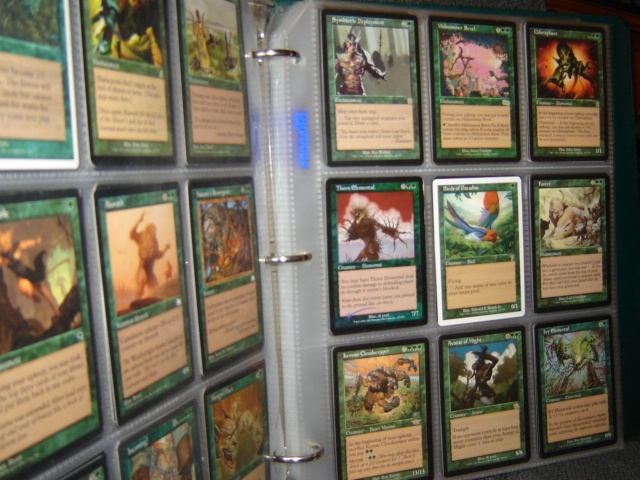
2. Best setup for set builders: sleeves and a ringless side-loading binder
Set builders need visibility as well as protection. A ringless binder with fixed pages lets a collector see sequence, gaps, variations, and progress without repeatedly removing cards. Side-loading pockets reduce accidental exit when the binder is carried upright, and fixed pages avoid the pressure that metal rings can place on nearby cards.
Test the binder with the exact inner sleeves you intend to use. A pocket may fit a bare card but become too tight once the card is sleeved. Thick inserts should not be pushed into ordinary nine-pocket pages. If the page bows, the pocket stretches, or the card requires pinching, use a separate holder.
Assign a binder code and record page and pocket locations. A code such as B02-P14-6 can identify binder two, page fourteen, pocket six. When a card leaves for a trade or grading review, use a neutral placeholder and update the record. This keeps the visual sequence useful and prevents an unexplained empty pocket.
Store binders vertically only when their construction supports it and pages do not sag; otherwise follow the manufacturer's guidance. Do not pile excessive weight on them. Keep them away from direct sunlight, damp walls, heaters, and floors.
Best for: complete sets, team runs, player timelines, and moderate-consequence cards that gain meaning from sequence.
Buy first: one ringless side-loading binder with disclosed materials, compatible inner sleeves, and a simple location record.
Avoid: ring pressure, overfilled pockets, unclear plastics, thick cards in standard pages, and decorative display in direct sun.
3. Best setup for bulk and inherited cards: supported card boxes
Bulk collections need safe density and triage, not hundreds of individual rigid cases. Use sleeves where surface or handling risk warrants them, then place cards in fitted rows inside sturdy card boxes. Smooth dividers and spacers keep partly filled rows from leaning and collapsing.
Start with broad labels such as sport, era, set, team, or review status. Avoid making irreversible sorting decisions before identifying variations and formats. An inherited lot may contain cards that look similar but require different handling because of size, coating, damage, or personal significance.
The U.S. National Archives advises using containers that fit items without folding or bending, preventing excessive movement, and avoiding overstuffing. Its guidance concerns papers and photographs rather than commercial sports cards, but the physical principles translate well: support items, give them appropriate space, and keep boxes away from water exposure.
Do not lift a long box by one end when it is heavily loaded. Place it on stable shelving where the box can be removed level. A shorter box that can be handled safely may be better than the maximum-capacity option. Label the outside and each row so a card can be returned to the correct location.
Best for: base cards, duplicates, large inherited lots, set-building inventory, and cards awaiting research.
Buy first: one or more manageable fitted boxes, known-material sleeves for selected cards, smooth dividers, and location labels.
Avoid: unsupported gaps, overfilled rows, floor storage, heavy boxes that flex, and premature assumptions about card importance.
4. Best setup for grading candidates: a small semi-rigid queue
Do not buy submission supplies simply because grading seems like a normal destination for cards. First identify a limited group that has been researched and inspected. Then create a dedicated queue with stages such as review, compare, ready, submitted, and returned.
Semi-rigid holders can be useful because they use space efficiently and support controlled card removal in many submission workflows. The selected grading company's current instructions should decide the required holder, packing sequence, paperwork, and labeling. Requirements can change, so do not rely on an old video or leftover supply list.
Use an appropriate inner sleeve and insert the card without pressure. Place semi-rigid holders upright in a supportive outer box so they do not bow. Record the card, its location, the reason for considering grading, condition observations, and the next decision. A queue without records becomes another forgotten pile.
The complete card grading guide helps evaluate the underlying choice, while the guide to buying card grading safely covers process and provider checks.
Best for: a small number of researched cards with an active grading decision.
Buy first: the holder and packing supplies specified by the selected service, a supportive queue box, and a tracking record.
Avoid: preparing unresearched cards, forcing insertion, mixing submitted and unsubmitted cards, and assuming encapsulation always justifies its cost.
5. Best setup for graded cards: a measured slab box
Once a new collector owns several graded cards, a dedicated box is easier to manage than mixing slabs with raw cards. Labels remain visible, cases stay upright, and the certification number can be matched with an inventory record quickly. Soft outer sleeves may reduce case scratches and hold a removable location code.
Measure the actual slabs. Holders differ among grading companies and can also change between generations from the same company. A "universal" box may have too much side movement, may catch a label shape, or may not close over a taller case. Buy one unit and test the complete mix.
Inventory grading company, grade, certification number, card identity, photographs, and box location. Keep purchase and insurance documentation in backed-up digital storage, not only on paper placed beside the cards. If a slab leaves for sale or review, update its status rather than creating an untracked holding pile.
Encapsulation does not make a card immune to heat, moisture, ultraviolet light, scratches, cracks, or impact. A slab box belongs in the same stable room and elevated shelving used for the wider collection.
Best for: starter collections with multiple graded cards or a deliberate slab-focused direction.
Buy first: a box tested against the exact case formats, optional slab sleeves, dividers, and certification-level inventory.
Avoid: trusting "universal" without measurement, stacking loose slabs, displaying labels in strong sun, and treating the case as disaster protection.
6. Best setup for selected display cards: magnetic holders
Magnetic holders present a card cleanly and add rigidity, making them appealing to new collectors. Their best use is narrow: a small number of showcase cards, especially thicker cards that match a precisely sized recess. They should not replace the general sleeve-and-top-loader system without a reason.
Depth must match the card. A shallow case may compress edges or surfaces; an overly deep case permits movement. Designs differ in corner clearance and whether a fitted inner sleeve can be used. Follow the manufacturer's instructions rather than adding a sleeve that prevents complete closure.
An outer bag can reduce case scratches and add another barrier against accidental opening. For transport, the case still needs immobilization, cushioning, and sturdy outer packaging. Its additional mass can cause damage if it moves inside a mailer.
Be cautious with ultraviolet-protection language. Product claims should be specific, but no clear case makes long-term direct sunlight a good display environment. Rotate display cards, limit light exposure, and keep permanent storage in a stable location.
Best for: a few display pieces, autographs, patches, and cards whose thickness has been measured.
Buy first: one correctly sized case, any manufacturer-approved inner protection, an outer bag, and a display location away from direct sun.
Avoid: guessing card thickness, dropping a loose magnetic case into a mailer, and assuming presentation changes card condition or market demand.
7. Best setup for shows and trades: a portable case with a manifest
Collectors who regularly attend shows or trade nights need a transport layer. A portable hard case with fitted rows can keep a selected group upright, separated, and easier to account for. Latches, hinges, handle strength, water-resistance claims, internal materials, and loaded weight all deserve attention.
Every card still needs individual protection. The case is the outer transport system, not a replacement for sleeves, top loaders, magnetic holders, or slabs. Internal foam should not shed, react with enclosures, or press cards against the lid.
Create a manifest before leaving. Record the card, home location, event location, and intended status. Reconcile every sale, trade, grading handoff, and return immediately after the event. This discipline prevents more inventory confusion than an expensive case used without records.
Do not leave the case in a vehicle. A parked car can expose cards to rapid temperature change, theft, and moisture. Return inventory to stable home storage promptly.
Best for: curated trade stock, show purchases, dealer appointments, and grading drop-offs.
Buy first: a case tested with the actual holders, smooth dividers, and a simple event manifest.
Avoid: loose cards, overloaded handles, undocumented movement, long vehicle storage, and assuming a case is waterproof without a defined rating.
8. Best setup for higher-consequence cards: layered security
Card safes rank last for beginners because security does not replace basic card protection. A safe can control access and address some theft, fire, or water scenarios, but the cards inside still need sleeves, holders, supportive boxes, location codes, and environmental attention.
Treat burglary resistance, fire resistance, and water resistance as separate specifications. Review test standards, duration, installation, anchoring, internal dimensions, floor loading, delivery path, emergency access, and insurer expectations. A safe that cannot hold the existing boxes or creates difficult humidity behavior may solve one risk while adding another.
Assign codes to shelves and internal boxes. Keep an encrypted or otherwise secure inventory copy away from the safe. Record removal for photography, grading, consignment, or sale. Limit access deliberately, but make sure authorized people can respond to an emergency.
Many starter collections do not need a safe yet. Moving boxes off the floor, improving doors and locks, documenting the collection, using discreet storage, and reviewing insurance may address the immediate risk more efficiently.
Best for: individually protected cards whose aggregate consequences justify controlled access and installation.
Buy first: only after reviewing risk, insurance, room conditions, dimensions, weight, installation, and internal organization.
Avoid: buying on fire rating alone, ignoring humidity, storing undocumented loose cards inside, and assuming one device covers every loss scenario.
Beginner decision table
| Collection pattern | Best first setup | Main benefit | Main caution |
|---|---|---|---|
| Raw singles | Sleeves, top loaders, fitted box | Visibility and bending resistance | Match thickness |
| Complete sets | Ringless side-loading binder | Sequence and easy viewing | Avoid tight pockets |
| Bulk or inherited lot | Supported card boxes | Safe density and triage | Do not overfill |
| Grading candidates | Semi-rigid queue | Clear submission workflow | Follow current service rules |
| Graded cards | Measured slab box | Certification-level organization | Case sizes vary |
| Display cards | Magnetic holders | Presentation and rigidity | Exact depth required |
| Shows and trades | Portable case plus manifest | Controlled transport | Theft and heat exposure |
| Higher-consequence cards | Layered security or safe | Access control | Installation and environment |
A starter shopping plan that avoids waste
Begin with a count by format rather than a total card count. Estimate how many ordinary cards need box storage, how many selected singles deserve rigid holders, and whether any thick cards need separate dimensions. Buy roughly enough for the immediate job plus a modest margin, not enough for an imagined future collection.
Choose one compatible path. Confirm that sleeves fit the cards, top loaders fit the sleeved cards, outer bags fit the top loaders, and the box fits the complete enclosure. Check that the lid closes without pressing holder tops. This chain matters more than any one premium feature.
Next, establish location codes. Name the box, row, binder, page, or slab section. A basic spreadsheet can record card identity, location, enclosure, condition notes, and status. Photographs and acquisition records can be added gradually.
Finally, place the system well. The U.S. National Archives recommends keeping papers and photographs away from damp basements, garages, hot attics, leaks, and flood sources and storing them on shelving. Sports cards differ from archival documents, but avoiding heat, moisture, water, and unstable floors is equally practical. The Smithsonian also emphasizes that appropriate enclosures reduce handling and stabilize materials for long-term access.
Before ordering a large case quantity, use the guide to buying sports card storage safely to evaluate measurements, material claims, seller details, and return policies.
Common beginner questions to ask before checkout
Can the seller identify the plastic or board material? Are the internal dimensions provided, not merely a marketing size? Does the holder fit the card after its intended sleeve is added? Does the box fit the complete holder? Can the product be returned after a small fit test? Are replacement units likely to remain available?
Also ask what problem the product solves. A display case does not organize bulk. A binder does not support a thick patch card. A top loader does not control room humidity. A safe does not prevent surface contact inside an unprotected stack. A product can be good and still be wrong for the current job.
Final verdict
The best storage option for a new sports card collector is a coordinated setup, not a universal holder. Start with safe sleeves and supportive boxes for ordinary cards. Use sleeves and correctly sized top loaders for selected raw singles. Let the shape of the collection choose the next branch: a ringless binder for sets, semi-rigid holders for an active grading queue, a measured box for slabs, or precise magnetic holders for a few display pieces.
Portable cases and card safes make sense when transport and access control become real responsibilities. Until then, careful handling, known materials, tested dimensions, stable shelving, separation from water, and a searchable inventory usually do more for a starter collection.
The right purchase is the one that solves today's storage job while remaining compatible with tomorrow's collection. Test before buying in volume, document where cards live, and add complexity only when the cards or workflow clearly require it.
Conclusion
The best collecting decisions usually come from structure rather than urgency. When you combine clear comparisons, strong context, and a disciplined buying framework, you give yourself a better chance to build a collection with both enjoyment and staying power.