Answer-first summary
For most new collectors, the best first storage purchase is a small compatible kit: sleeves for direct surface protection, top loaders for selected raw singles, and fitted boxes that keep both ordinary cards and protected singles supported. At roughly 25 protected cards, establish fit and labeling; around 250 total cards, separate bulk, sets, and selected singles; beyond that, add binder, grading, slab, display, travel, or security lanes only when the collection proves it needs them.
The short answer: begin with a kit, not a storage room
The best sports card storage for a new collector is usually a three-part starter kit: known-material inner sleeves, a small quantity of top loaders matched to the cards' actual thicknesses, and supportive boxes sized for ordinary cards and protected singles. That kit handles the two jobs beginners face first. It limits direct contact with selected cards, and it prevents the wider collection from becoming loose stacks with no fixed location.
Do not buy every category of holder at once. A binder is valuable when a set, player run, or team collection benefits from page-by-page viewing. Semi-rigid holders belong in an active grading workflow. Slab boxes matter after graded cards accumulate. Magnetic holders suit a narrow display or thick-card role. Portable cases and card safes answer transport and access-control problems. Each can be an excellent choice at the right stage and unnecessary inventory at the wrong one.
This guide uses collection-size checkpoints rather than ranking products by price or appearance. The numbers are not rigid thresholds. They are moments to stop, examine how you use the collection, and buy only the next missing function. For the preservation principles behind room placement, enclosures, and handling, use the complete sports card storage guide. The plan below concentrates on purchase order and upgrade timing.
Stage zero: audit before buying supplies
Start with a clean, dry work surface and only as many cards as you can safely handle. Separate obvious formats without trying to price everything. Useful groups are standard raw cards, visibly thick cards, coherent sets or runs, cards already in rigid holders, graded cards, and cards needing more research. Isolate anything damp, moldy, sticky, or shedding material instead of placing it against clean cards.
Measure the formats you own. Standard dimensions do not guarantee standard thickness, and memorabilia cards, chromium stock, stickers, minis, vintage issues, and unusual inserts can require different supplies. Read manufacturers' internal measurements and test a small pack. A holder that requires pressure, bows after closing, or lets a card move freely is not a successful fit.
Also inspect the destination. Choose elevated, stable shelving away from direct sunlight, exterior moisture, plumbing risk, heaters, and rapid temperature swings. The U.S. National Archives recommends containers that fit without bending or excessive movement and emphasizes cool, relatively dry storage for family papers and photographs. Sports cards are commercial objects with varied inks, coatings, and constructions, so archival guidance is a useful physical baseline rather than a product guarantee.
Write down three facts before ordering: how many ordinary cards need supported bulk storage, how many selected raw singles need individual protection, and which exceptional formats need a fit test. That small audit is more useful than estimating the collection by the height of a stack.
Checkpoint one: the first 25 selected cards
At this stage, spend on correct fit and a repeatable handling routine rather than variety. Sleeve selected raw singles with clean, dry hands, holding each card by its edges. Insert the sleeved cards into correctly sized top loaders and keep the finished holders upright in a box designed for them. Use smooth spacers so a partly filled row cannot slump.
Top loaders are the best first rigid upgrade because they are visible, replaceable, widely understood, and available in several depths. They work for collection storage, photography, trade preparation, and many shipping workflows. Their limitations are equally important: they are open at one edge, can scratch, occupy more space than raw cards, and do not create a controlled environment. The outer box remains part of the system.
Use removable location labels on an outer bag, divider, or box—not on the card. A simple code such as R01-014 can mean raw-singles box one, position fourteen. Record enough information to return a card after photography or research. The purpose is not database perfection; it is eliminating repeated searches and accidental handling.
Buy only a modest reserve. If you own 18 selected singles, a pack that brings capacity to 25 or 30 is more informative than a case of 1,000. You may discover that some cards need a deeper holder, the outer bags do not fit the chosen top loaders, or the box is too narrow once labels are attached. Correcting that lesson after a test pack is easy.
At the end of this checkpoint, every selected raw card should have a known location, and ordinary cards should no longer be balanced in unsupported piles. That outcome matters more than whether every card has identical branding around it.
Checkpoint two: around 250 total cards
Once the collection reaches a few hundred cards, the main problem shifts from individual protection to separation and retrieval. Divide the collection into lanes: ordinary bulk or set inventory, selected raw singles, unusually thick cards, and research or decision queues. Each lane needs a container suited to its dimensions and frequency of access.
For ordinary cards, use fitted card boxes with smooth dividers and enough support to keep rows upright. Do not top-load every base card simply to make the collection feel serious. Safe density preserves shelf space and leaves budget for proper boxes, stable shelving, and supplies for cards that are actually handled often or difficult to replace.
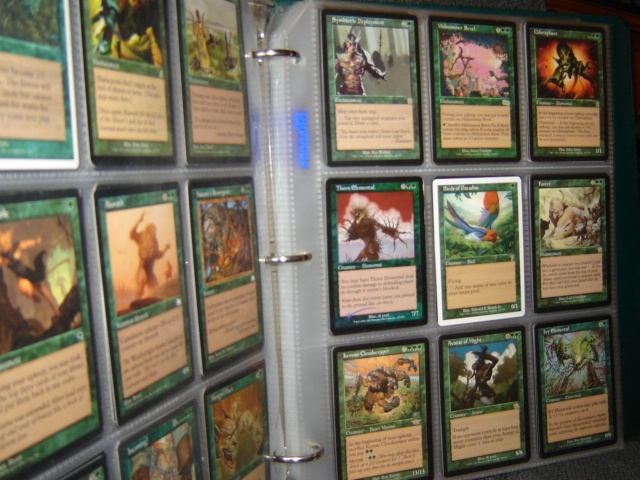
If sequence creates value for you—a complete set, a season, a team, or a player timeline—this is the first point at which a binder may solve a genuine problem. Prefer a construction that does not expose cards to ring pressure, and test side-loading pockets with the exact sleeves you use. Do not force thick cards into standard pockets or double-load pockets until they bulge. Give the binder its own location code and record page positions.
The Smithsonian Institution Archives notes that enclosure choice depends on handling frequency, format vulnerability, cost, and space, and that difficult formats may need custom housing. The same decision logic helps a collector: the best enclosure is not universally the thickest one, but the one that safely supports a specific format during its normal use.
Revisit the shelf at this checkpoint. A box that is easy to move when half full may become unsafe or flexible at full weight. Shorter boxes can be better than maximum-capacity boxes if they are easier to lift level. Keep all boxes off the floor, leave labels visible, and avoid stacking weight on binders.
Checkpoint three: when grading becomes an actual project
Interest in grading does not require a new holder lane. A researched group of cards with an intended submission does. Create a small queue with statuses such as inspect, compare, ready, submitted, and returned. Record condition observations and the reason each card remains in the queue.
Use the current instructions from the selected grading company to choose semi-rigid holders, inner sleeves, packing, forms, and labeling. Requirements can change, so an old video is not a reliable supply specification. Buy enough submission materials for the current batch plus replacements, not enough for every card that might someday be graded.
Keep semi-rigid holders supported so they do not bow, and do not force a card into a tight sleeve or holder. Separate prepared cards from ordinary inventory and from cards still under consideration. The complete card grading guide explains the decision itself, while the guide to buying card grading safely covers provider and process checks.
When slabs return, measure the actual cases before buying a slab box. Case heights, widths, label shapes, and thicknesses vary among companies and generations. Test the full mix you own. A dedicated slab box with soft outer sleeves and dividers can make certification numbers easy to match to records, but encapsulation does not remove heat, moisture, light, impact, or theft risk.
Checkpoint four: display cards and magnetic holders
Magnetic holders belong after you can name the cards they will serve. They are useful for a few showcase pieces or thick cards when the recess depth fits precisely and the closure does not contact or compress the card. They are not the automatic next step after top loaders.
Check card thickness, corner clearance, sleeve compatibility, and complete closure. Follow the case manufacturer's instructions. Adding an unapproved inner sleeve can prevent closure; omitting protection where the design expects it can allow surface contact. An outer bag helps reduce case scratching and accidental opening.
Treat display location as part of the product choice. Claims about ultraviolet resistance do not make long-term direct sunlight harmless. Keep displays away from windows, heat, and unstable humidity, and rotate cards if display is important. For transport, immobilize the heavier case inside a supportive outer container. A magnetic holder moving inside a mailer can become the source of impact rather than the protection from it.
Choose magnetic holders for presentation and fit, not because a card crossed an arbitrary price line. A well-fitted sleeved top loader stored in a supportive box can be the more sensible option for a valuable card that is rarely displayed.
Checkpoint five: shows, trades, and temporary movement
A portable case becomes useful when cards routinely leave home for shows, trade nights, dealer appointments, or grading drop-offs. Test it with the actual mix of top loaders, magnetic holders, and slabs. Inspect row width, internal materials, latch strength, hinge movement, handle load, and the meaning of any water-resistance claim.
Individual card protection remains necessary inside the case. Use spacers so holders cannot accelerate into one another. Create a manifest with each card's home location, event location, and status. Reconcile sales, trades, handoffs, purchases, and returns as soon as the event ends.
Do not turn a vehicle into storage. Parked cars can create rapid temperature shifts and add theft exposure. Move the cards directly, keep the case under control, and return them to stable home storage promptly. If a portable case is used only twice a year, store it empty rather than letting the collection live permanently in a transport environment chosen for mobility.
Checkpoint six: card safes and layered security
Card safes are a later security decision, not the top tier of card holder. A safe can restrict access and make opportunistic removal harder, but it does not individually support cards, document ownership, control every internal condition, guarantee protection from fire or water, or replace an insurance conversation.
Before buying, identify what will go inside and calculate the space using the cards' real enclosures. Review internal dimensions, shelf loads, anchors, installation location, delivery path, lock access, backup access, fire-test details, water limitations, and how the safe affects humidity. Do not place raw cards loose inside it. Sleeves, holders, boxes, dividers, and inventory remain necessary.
Keep photographs, purchase records, certification numbers, and a location inventory in backed-up storage separate from the collection. Review whether an insurer requires specific documentation, limits, appraisals, or security measures. Avoid publishing precise home storage or security details when sharing the collection online.
A smaller documented group in layered protection may be more manageable than filling a large safe with poorly cataloged material. The buying checklist in how to buy sports card storage safely helps compare material claims, dimensions, seller identity, and return terms before a large storage purchase.
A practical purchase ladder
Use this order as a default, then skip any step the collection does not need:
- Clean workspace, known-material sleeves, fitted card boxes, smooth dividers, and a basic inventory.
- Correctly sized top loaders and compatible outer storage for selected raw singles.
- A tested binder only for a collection that benefits from visual sequence.
- A small grading queue and current submission supplies only for an active project.
- A measured slab box after graded cards have accumulated.
- Magnetic holders only for named display or thick-card roles.
- A portable case and manifest for repeated movement.
- A card safe or other access-control layer after documentation, installation, insurance, and internal storage have been planned.
At every step, buy a test quantity, assemble the complete system, and practice retrieval. Check whether labels remain readable, rows stay upright, lids close without pressure, and the filled container is safe to move. Keep a modest reserve of proven supplies, but do not mistake unused capacity for protection.
Budget for the system around the holder
Compare storage choices by completed cost, not the shelf price of one component. A top loader lane may require inner sleeves, several holder depths, outer bags, a fitted box, dividers, and labels. A binder may require compatible sleeves and additional volumes once a set expands. A magnetic holder may need an outer bag, a stand, and a transport solution. A safe can add delivery, anchoring, interior boxes, monitoring, and insurance-related costs.
This does not mean choosing the cheapest option. It means identifying the smallest complete system that performs the job. A low-cost holder that does not fit the available boxes can produce more expense and handling than a slightly more expensive format with dependable replacement supplies. Conversely, a premium holder bought for every ordinary card can consume the budget that should have gone to stable shelving or water-risk reduction.
Check replacement availability before standardizing. If a divider breaks or a box fills, can you obtain the same dimensions without rebuilding the row? If an outer sleeve clouds or tears, is its size documented? Record product dimensions and the date of the fit test rather than relying only on a brand name, because product lines and specifications can change.
Set a review point instead of an automatic reorder. When the reserve falls to a chosen level, count how many supplies were used correctly, how many were the wrong size, and whether the collection's direction changed. Reorder proven items; do not replenish mistakes simply because they are now part of the shelf. This habit keeps the storage system adaptable and makes each later purchase easier to explain.
Common buying mistakes at each stage
The first mistake is ordering around a hypothetical future collection. Large orders lock in wrong dimensions and consume space before you know whether you prefer sets, raw singles, slabs, or display cards.
The second is treating price as the holder specification. Card format, thickness, surface, handling, and use select the enclosure. Market price may affect the consequence of failure, but it does not make an ill-fitting case fit.
The third is buying individual holders without planning their outer container. Sleeves, top loaders, magnetic cases, and slabs all need supported storage. Compatibility includes the box, shelf, labels, and retrieval routine.
The fourth is believing a premium product removes environmental risk. No ordinary hobby holder makes a damp floor, hot vehicle, direct sun, unstable attic, or leaking pipe a good storage location.
The fifth is adding security before inventory. If you cannot identify what is stored, where it is, and what documentation exists, a heavier container solves only part of the problem.
Final recommendation
For most new collectors, top loaders earn the first specialist purchase because they add useful rigidity without forcing the whole collection into an expensive format. Pair them with suitable sleeves and a fitted outer box. Use supported card boxes for ordinary inventory, and add a binder only where page sequence improves the collection.
After that, let behavior trigger spending. A real submission creates the need for a grading lane. Accumulating slabs creates the need for measured slab storage. Named display cards can justify magnetic holders. Repeated travel can justify a portable case. Documented higher-consequence holdings may justify a card safe and an insurance review.
The best beginner system is not the one with the most layers. It is the one you can use correctly every time: measured, supported, labeled, retrievable, placed in a stable part of the home, and expanded only after the next job becomes clear.
Conclusion
The best collecting decisions usually come from structure rather than urgency. When you combine clear comparisons, strong context, and a disciplined buying framework, you give yourself a better chance to build a collection with both enjoyment and staying power.