Answer-first summary
Choose beginner sports card storage by the most likely failure. Use sleeves to reduce direct surface contact, correctly sized top loaders to resist bending during ordinary handling, and fitted boxes to support both raw and protected cards. Use a ringless binder only when viewing order reduces repeated removal; a semi-rigid queue only for an active grading process; magnetic holders only for measured display cards; a portable case only for repeated transport; and a card safe only as one layer of access control.
The short answer: buy against a failure, not a feeling
For most new collectors, the best storage system is straightforward: known-material inner sleeves reduce direct surface contact, correctly sized top loaders add bending resistance to selected raw cards, and fitted card boxes support ordinary inventory and protected singles. This combination addresses the most common early failures without requiring every card to enter an expensive or complicated holder.
Other products belong only when you can name the risk they control. A ringless side-loading binder may reduce repeated removal when a set is viewed in sequence. Semi-rigid holders can organize an active grading submission. A measured slab box keeps encapsulated cards upright. Magnetic holders can present a few suitable cards. A portable case controls movement during travel. A card safe restricts access. None is automatically safer in every context.
The useful question is not, “Which holder looks strongest?” It is, “How is this card most likely to be damaged, misplaced, or mishandled in my collection?” Once that failure is clear, choose the smallest compatible system that reduces it without adding pressure, difficult retrieval, excess movement, environmental exposure, or false confidence.
For a broader preservation and organization framework, read the complete sports card storage guide. This article ranks storage by the risks a beginner can identify and control.
Start with a simple risk audit
Look at the cards, their current enclosures, and the room before shopping. Work with manageable groups on a clean, dry surface. Hold cards by their edges with clean, dry hands. Separate standard raw cards, thick cards, complete or partial sets, active trade inventory, grading candidates, slabs, and anything with moisture, mold, stickiness, or material loss. Isolate a suspect item rather than inserting it beside clean cards.
Write down how each group is normally used. Is it viewed weekly, rarely removed, taken to shows, photographed for sale, compared in set order, or waiting for grading? Frequency matters because a technically strong enclosure can still be a poor choice if it makes normal retrieval awkward. Awkward storage encourages prying, pinching, bending, and temporary piles.
Check card dimensions and thickness. “Standard card” is not enough for memorabilia cards, chromium stock, stickers, minis, vintage formats, and unusual inserts. Compare manufacturer specifications and test a small quantity. Force, visible bowing, corner contact, incomplete closure, or free sliding are signs to stop.
Finally, inspect placement. Prefer stable, elevated shelving away from direct sunlight, exterior damp, plumbing, heaters, and rapid changes in temperature or humidity. The U.S. National Archives advises fitted containers that limit bending and excessive movement and recommends cool, relatively dry conditions for family papers and photographs. Sports cards vary in construction, so these principles are a baseline for physical risk—not a guarantee that any product is archival.
Risk 1: surface wear from direct contact
Fingerprints, dust, grit, sliding, and repeated removal can affect a card's surface. A clean inner sleeve is the first response for selected raw cards because it creates a replaceable contact layer. The sleeve should be made from a disclosed material, fit without pressure, and allow controlled insertion.
Open the sleeve rather than pushing the card against a closed edge. Guide the card by its sides and stop if a corner catches. Avoid adhesive touching the card. Resealable flaps, labels, and tape belong on an outer enclosure where they cannot migrate onto the card during removal.
A sleeve alone has limited bending resistance, so store sleeved cards upright in a fitted box with smooth dividers and spacers. Do not leave them loose in a drawer. If a selected single is handled frequently, difficult to replace, or prepared for trade or photography, add a rigid outer holder.
Best for: reducing ordinary surface contact on raw cards while preserving compact storage.
Does not solve: bending, crushing, unstable room conditions, water exposure, theft, or inventory confusion by itself.
Risk 2: bending during handling and retrieval
A sleeved card in a correctly sized top loader is the strongest general beginner choice for selected raw singles. The inner sleeve limits direct contact; the rigid holder resists ordinary bending; a fitted top-loader box supports the finished unit. Each layer has a separate job.
Match holder depth to the card. A shallow holder can compress edges or surfaces, while excessive depth permits movement. Test the inner sleeve, top loader, optional outer bag, divider, and box together. A component that fits alone may fail once the complete system is assembled.
Top loaders remain open at one edge and can scratch, so they are not sealed environmental chambers. An outer bag can reduce dust, keep the card from sliding out, and hold a removable location label. The completed holder still belongs upright in a supportive box, not in a leaning desk pile.
Do not top-load every inexpensive base card automatically. The added volume can make boxes heavy, consume shelf space, and divert money from reliable shelving and correct supplies. Use the rigid layer where bending consequence, handling frequency, replacement difficulty, or personal importance justifies it.
Best for: selected raw singles, frequently handled cards, trade candidates, and cards photographed or researched repeatedly.
Does not solve: direct sunlight, high humidity, water, uncontrolled transport, or unauthorized access.
Risk 3: slumping, compression, and overloaded bulk storage
Large groups of ordinary cards are more safely managed through support than through individual rigid holders. Choose boxes fitted to the card format, use smooth dividers, and fill empty row space with stable spacers. Cards should remain upright without being compressed.
Overfilled rows create pressure and difficult removal. Underfilled rows without spacers lean, slump, and can develop curved groups. Mixed dimensions may catch against one another, so separate unusual formats. Do not use rubber bands, direct adhesive, or rough improvised dividers.
Consider the filled weight. A long box that feels manageable when empty may flex or become unsafe to lift when full. Shorter boxes may cost more per card but reduce the chance of dropping or twisting a heavy row. Place boxes where they can be removed level and keep them off the floor.
Give each box and row a location code. A basic inventory should identify the group, location, and any card temporarily removed. Organization reduces physical risk because cards can be found without repeatedly disturbing unrelated stacks.
Best for: base cards, duplicates, inherited lots, set-building inventory, and lower-consequence cards awaiting research.
Does not solve: frequent display, individual bending protection, active transport, or high-consequence access control.
Risk 4: damage caused by repeated searching
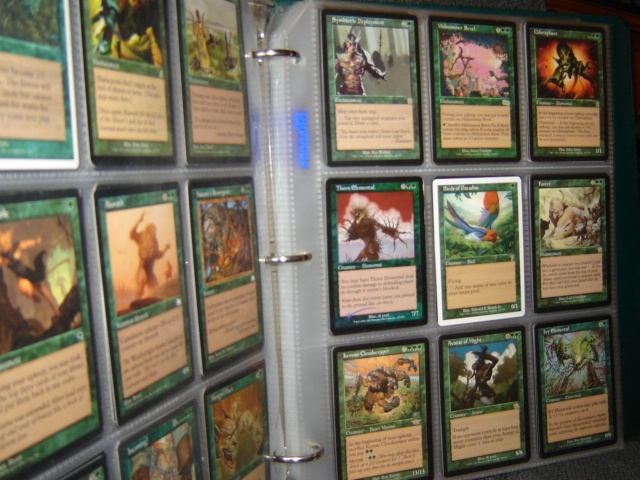
Some collections are harmed less by static storage than by constant removal. A ringless side-loading binder can reduce searching and handling when sequence matters: complete sets, team runs, player timelines, or visual checklists. Fixed pages avoid ring pressure, while side-loading pockets reduce accidental exit.
Test the exact sleeve and pocket combination. A pocket that fits a bare card may become too tight after sleeving. Do not force thick cards into ordinary pages or place multiple cards in a pocket until the page bows. If a card needs rigid protection, keep it in a separate singles box and use a recorded placeholder in the sequence.
Assign binder, page, and pocket codes. When a card leaves for photography, grading, sale, or trade, update the record. Empty pockets without status invite repeated searches and mistaken assumptions.
Store binders according to their construction, without excessive weight on top. Keep them away from strong light and unstable walls. A binder is a retrieval tool, not proof that every pocket material or viewing location is suitable for long-term preservation.
Best for: coherent collections where seeing order prevents repeated removal.
Does not solve: thick-card fit, rigid bending protection, shipping, or security.
Risk 5: mixing grading candidates with ordinary inventory
Grading creates a workflow risk before it creates a storage need. Cards can be reconsidered, prepared, submitted, returned, or rejected. Without a dedicated queue, candidates become indistinguishable from ordinary protected singles or remain in temporary stacks.
Create statuses such as inspect, compare, ready, submitted, and returned. Record the card, location, condition observations, and next action. Only move a card into the submission lane when there is a real decision process, not merely because grading is popular.
Follow the selected grading company's current instructions for inner sleeves, semi-rigid holders, labels, paperwork, and packing. Requirements can change. Support semi-rigid holders upright so they do not bow, and never force a card into a tight enclosure.
The complete card grading guide covers the underlying decision. The guide to buying card grading safely addresses provider identity, process, fees, and submission checks.
Best for: a researched, active submission group with defined statuses.
Does not solve: whether grading is worthwhile, correct provider selection, or protection after slabs return.
Risk 6: slab scratches, unstable stacks, and lost certification data
Graded cards arrive in rigid cases, but loose slabs still scratch, slide, stack poorly, and become separated from records. Once several accumulate, measure their actual dimensions and test a dedicated slab box. Cases vary among grading companies and can change across generations.
Soft outer sleeves may reduce case scratches and provide a surface for location labels. Dividers and fitted rows keep cases upright. Record the grading company, grade, certification number, card identity, photographs, purchase documentation, and box location.
Do not treat encapsulation as complete protection. Slabs can crack and remain vulnerable to heat, moisture, light, impact, and theft. A slab box makes retrieval and inventory safer; it does not turn an unsuitable room into a safe environment.
Best for: collections with multiple graded cards and certification-level inventory.
Does not solve: environmental placement, case authenticity, insurance, or unauthorized access.
Risk 7: poor fit in display storage
Magnetic holders can be excellent for a small number of display or thick cards, but their clean appearance can hide fit risk. The recessed depth, corner design, sleeve compatibility, and closure must match the exact card. A holder that closes under pressure or leaves too much space is not an upgrade.
Follow the manufacturer's instructions. An unapproved inner sleeve can prevent full closure; a bare card in an incompatible design can contact the case. Use an outer bag to reduce case scratches and accidental opening. Check the stand as well as the holder so the complete display is stable.
Light is part of display risk. Ultraviolet-resistance claims do not make direct sunlight harmless. Keep cards away from windows and heat, limit exposure, and rotate display pieces. During transport, immobilize the heavier magnetic case inside a suitable outer container.
Choose magnetic holders for a defined presentation or thick-card role, not because a card crossed an arbitrary price point. A sleeved top loader in a fitted box may be safer for a valuable card that is rarely shown.
Best for: precisely measured showcase cards and some thick formats.
Does not solve: long-term light exposure, transport by itself, environmental control, or theft.
Risk 8: movement during shows, trades, and shipping preparation
A portable case is justified when inventory repeatedly leaves home. Test it with the actual mixture of top loaders, magnetic holders, and slabs. Inspect row dimensions, interior materials, dividers, latches, hinges, handle load, and the meaning of any water-resistance claim.
The case is an outer transport layer; every card still needs individual protection. Fill unused space with suitable spacers so holders cannot accelerate into one another. Create a manifest showing each card's home location, travel location, and status. Reconcile trades, sales, purchases, grading handoffs, and returns immediately.
Do not store cards in a parked vehicle. Cars introduce rapid temperature change and theft exposure. Move the case directly, keep it under control, and return cards to stable home storage after the event. If the case is used occasionally, store it empty rather than making a mobile container the permanent home.
Best for: recurring shows, trade nights, dealer appointments, and grading drop-offs.
Does not solve: individual card fit, prolonged environmental exposure, or complete theft protection.
Risk 9: unauthorized access and incomplete documentation
Card safes rank late because access control should be layered over correct storage, not substituted for it. A safe can make opportunistic removal harder, but it does not individually support cards, prove ownership, maintain every internal condition, guarantee protection from fire or water, or replace insurance review.
Calculate space using the real sleeves, holders, boxes, and dividers that will remain around the cards. Review interior dimensions, shelf loads, delivery route, anchoring, lock operation, backup access, fire-test details, water limitations, and how the interior behaves with humidity. Never place raw cards loose inside.
Keep photographs, receipts, certification numbers, appraisals when relevant, and location records in backed-up storage separate from the collection. Ask the insurer about limits, documentation, valuation, and security requirements. Avoid sharing precise home storage or access details online.
Before a large purchase, use the guide to buying sports card storage safely to evaluate dimensions, materials, claims, seller identity, and return terms.
Best for: documented higher-consequence holdings that already have suitable individual and outer protection.
Does not solve: inventory, insurance, individual fit, room conditions, or emergency planning by itself.
How to compare two storage options
When two products appear suitable, compare the complete systems rather than isolated holders:
- Which specific failure does each option reduce?
- Does the card fit without pressure or movement?
- Are all contact materials disclosed and appropriate for the intended use?
- Can the card be inserted, inspected, and removed without awkward handling?
- What outer box, divider, bag, stand, shelf, or case is still required?
- Can replacement supplies with the same dimensions be obtained later?
- Does the filled system remain safe to lift, label, inventory, and transport?
- What risk remains after the purchase?
Buy a small test quantity and assemble the full chain. Practice retrieval, check corners and closure, fill the row, read the label from the shelf, and move the container as it will be used. A product that passes an isolated fit test can still fail as part of an overloaded or incompatible system.
Recheck the result after several weeks of normal use. Look for scratched holders, leaning rows, labels that detach, cards that are difficult to retrieve, boxes that have become too heavy, and temporary piles forming beside the system. Those observations reveal whether the original risk was actually reduced or merely moved elsewhere. Adjust the weak component before standardizing on a larger quantity, and record the dimensions of the combination that worked.
Common false signals of safety
Thickness can feel safe while creating pressure or difficult removal. A tight fit can feel secure while damaging corners. A premium price can imply quality without disclosing material or internal dimensions. A sealed appearance can encourage display in sunlight. A heavy safe can create confidence without inventory, anchoring, or suitable internal boxes.
Another false signal is uniformity. Identical holders look orderly, but a mixed collection contains different card thicknesses, surfaces, uses, and consequences. Consistent location codes and handling rules are more valuable than forcing every item into the same enclosure.
Finally, do not confuse unused capacity with preparedness. Buying years of untested supplies creates a new storage problem. Keep a modest reserve of proven components and review the system when the collection changes.
Final recommendation
Start with the frequent, understandable risks. Use suitable inner sleeves to reduce surface contact, top loaders for selected cards that need bending resistance, and fitted boxes with smooth dividers for support. Add a ringless binder only where sequence reduces handling, and create a semi-rigid queue only for an active grading project.
Measure slabs before buying their box. Reserve magnetic holders for named display or thick-card roles. Use portable cases for repeated movement and card safes for layered access control after documentation, insurance, installation, and internal storage have been considered.
The best storage choice is not the product with the strongest visual promise. It is the system that controls a real failure, fits the exact card, remains easy to use correctly, and leaves the collection supported, identifiable, and stable when no one is handling it.
Conclusion
The best collecting decisions usually come from structure rather than urgency. When you combine clear comparisons, strong context, and a disciplined buying framework, you give yourself a better chance to build a collection with both enjoyment and staying power.