Answer-first summary
For most collectors, the strongest sports card storage combines a soft non-PVC sleeve, a properly sized rigid holder, and an archival-quality box kept upright in a cool, dry, stable room. Binders, magnetic holders, display cases, graded-card boxes, and safes are useful when their specific access or protection benefits match the cards inside.
The short answer: use a layered storage system
There is no single best container for every sports card. A practical collection usually needs three layers: a soft sleeve that protects the surface, a rigid holder that resists bending and corner damage, and an outer box or cabinet that limits dust, light, movement, and accidental contact. The right combination depends on the card's thickness, value, condition, grading plans, and how often you want to see it.
For ordinary raw cards, a quality penny sleeve inside a correctly sized top loader, stored upright in a purpose-built card box, is the most useful default. Complete sets and lower-value collections that are handled often may work better in side-loading, ringless binders. Selected display cards can justify magnetic holders. Graded cards need boxes with the right internal dimensions. Higher-value groups may belong in a suitable safe, but only after humidity and documentation have been considered.
Storage does not improve a card's condition. It slows avoidable damage. The aim is therefore not to buy the most expensive accessory; it is to remove the most likely failure points: abrasion, bending, pressure, ultraviolet light, moisture, heat, dust, chemical migration, careless handling, and disorganization.
If you are designing a system from scratch, start with the detailed sports card storage collector guide, then use this ranking to decide which containers deserve space in your setup.
How we evaluated the options
We assessed each option on six practical questions.
- Does it protect the card from common physical damage? A holder should reduce bending, corner impacts, surface contact, and movement without squeezing the card.
- Are its materials appropriate? Products sold for cards should be free of plasticizers that can migrate, and paper-based dividers or boxes should be described as acid-free or archival-quality when long-term contact is expected.
- Is the size correct? Standard cards, thick memorabilia cards, booklets, tobacco-sized cards, and graded slabs need different dimensions. A respected holder in the wrong size is still the wrong holder.
- Can the collection be handled safely? Good storage makes retrieval predictable. If cards catch on edges, slide out, or require dismantling a stack, handling risk rises.
- Does it scale? A magnetic holder may be sensible for ten favorites and impractical for ten thousand base cards.
- Does it fit the collection's purpose? Set builders, registry collectors, dealers, display-focused collectors, and family archivists need different balances of visibility, density, and security.
The ranking favors broad usefulness, not status. The best option is the one that solves the actual risk without creating a new one.
1. Penny sleeves plus top loaders: the best all-purpose system
The penny-sleeve-and-top-loader combination remains the most practical choice for most raw sports cards. The sleeve provides a smooth barrier against surface abrasion and fingerprints. The rigid top loader supports the card and shields its corners and edges from routine knocks. Together, they are inexpensive enough to use consistently and familiar enough that replacements are easy to find.
Fit matters. Insert the card gently into a clean sleeve, then guide the sleeved card into a top loader made for its thickness. Do not force a thick patch or jersey card into a standard holder. Compression can damage edges, create surface pressure, or make removal dangerous. Conversely, a holder that is much too large lets the card move and strike its inner walls.
Top loaders work best when stored upright in a fitted box with modest spacing. They should not lean at a sharp angle or carry the weight of a tall horizontal stack. Team bags or resealable outer sleeves can reduce dust and prevent the card from sliding out, particularly during transport. Avoid adhesive contact near an exposed card edge.
This system is not airtight, fireproof, or ideal for display. It is simply a strong balance of protection, cost, availability, and organization. That makes it the best baseline for rookie cards, inserts, parallels, autographs, and other raw cards that deserve individual protection.
Best for: most individually stored raw cards.
Watch for: incorrect thickness, cracked holders, debris inside sleeves, and overfilled boxes.
2. Archival card boxes: the best outer layer
A card box is less glamorous than a display case, but it often does more daily protective work. A well-fitted box keeps holders upright, blocks most light, reduces dust, and turns a loose group into an organized unit. Boxes are available for loose sleeved cards, top loaders, semi-rigid holders, and graded slabs, so the internal dimension is more important than the marketing name.
Choose sturdy, clean materials and avoid boxes with strong odors, visible residue, dampness, or rough internal surfaces. For long-term paper contact, archival-quality and acid-free descriptions are useful starting points, although those labels do not excuse poor environmental storage. The Library of Congress and National Archives both emphasize cool, dry, stable conditions for paper-based material; a premium box in a hot attic remains a poor system.
Use inert dividers with labels that do not rub card surfaces. Leave enough space to remove a card without pinching it, but not so much that rows collapse when the box moves. Heavy boxes should be sized so they can be lifted level with two hands. A large box filled beyond comfortable weight invites drops and sudden tilting.
Organization adds protection. Label by sport, year, set, player, or inventory number, and keep a separate digital inventory for important cards. When you can locate a card without searching through unrelated rows, you reduce handling.
Best for: long-term organization of sleeved, top-loaded, semi-rigid, or graded cards.
Watch for: excessive weight, damp storage areas, abrasive dividers, and loosely packed rows.
3. Ringless side-loading binders: the best browsable option
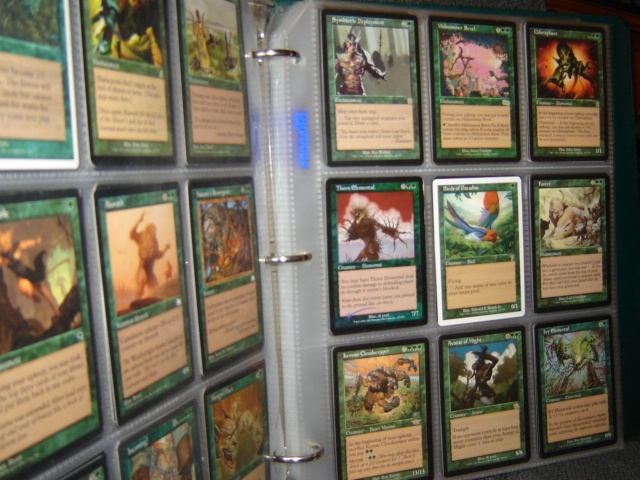
Binders are the most satisfying way to browse a set, player run, or team collection. A good ringless binder lies reasonably flat, uses fixed pages, and loads cards from the side so they are less likely to fall out. Sleeved cards should fit without pressure. A zipper closure can add dust resistance and keep the binder closed during movement.
Traditional three-ring binders are less attractive for important cards because rings can press into pages, especially when a binder is overfilled or stored poorly. Pages may sag, and cards near the rings can be exposed to uneven pressure. Fixed-page binders remove the ring mechanism, though they also prevent page replacement.
Binder storage requires discipline. Keep binders upright like books only when their construction supports it and the pages do not slump; otherwise store them flat in a short, stable stack according to the maker's guidance. Do not pile enough weight on top to press card impressions into adjacent pages. Keep them away from direct sunlight, radiators, exterior walls with condensation, and floors at risk of leaks.
Binders are not the first choice for very thick cards, cards with fragile surface finishes, or the collection's most valuable pieces. Their strength is access. A binder encourages collectors to enjoy and understand the cards as a group, which is a legitimate storage benefit when the materials and fit are sound.
Best for: complete sets, player runs, team collections, and cards viewed frequently.
Watch for: PVC pages, ring pressure, page sag, overfilling, and prolonged light exposure.
4. Semi-rigid holders: the best for grading submissions and compact staging
Semi-rigid holders occupy a useful middle ground between sleeves and top loaders. They support a sleeved card while remaining thinner and more flexible than a top loader. Many grading submission workflows favor them because a card can be removed in a controlled way without cutting a rigid case.
They are excellent for short-term staging, cataloging, shipping preparation, and collections that need more density than top loaders provide. The card should enter without being forced, and the sleeve should protect the surface from the holder's edges. A pull tab attached to the sleeve—not to the card—can make removal easier if the grading company permits it.
Semi-rigids are not automatically superior for permanent household storage. Their flexibility means they benefit from a strong outer box, and an exposed opening still allows dust or moisture exchange. They can bow when packed badly. Use them because the workflow benefits from them, not because professional graders use them.
Before sending a card, review the grading company's current packaging rules. If you are unsure whether grading fits the card, the card grading collector guide explains the decision framework, while the guide to buying card grading services safely covers practical verification.
Best for: submission preparation, temporary sorting, and space-efficient protected storage.
Watch for: bending, overpacking, forced insertion, and incompatible submission instructions.
5. Magnetic holders: the best presentation-focused enclosure
Magnetic one-touch holders make selected cards easy to display and inspect. They have a clean profile, rigid construction, and no screw to overtighten. For a favorite autograph, patch card, or visually strong rookie, the presentation can feel more intentional than a top loader.
The correct point size is essential. A card that is too thick may be compressed when the case closes. A thin card in a deep recess can shift. Measure or check the manufacturer's size guide, and inspect the holder for dust or plastic fragments before use. Some holders accept a card in a penny sleeve; others are designed around direct placement or an inner-fitting sleeve. Follow the exact product design rather than improvising.
A magnetic holder can open when dropped. A resealable outer bag adds dust protection and helps keep the halves together, but it does not make the holder impact-proof. For display, choose a stand that supports the holder securely and position it away from direct sunlight. Ultraviolet-resistant claims can reduce exposure, not make indefinite sunlight safe.
Magnetic holders become costly and bulky at scale. Reserve them for cards whose display value or thickness justifies the enclosure.
Best for: selected display cards, thicker memorabilia cards, and compact showcases.
Watch for: wrong point size, trapped debris, case separation, and direct sunlight.
6. Graded-card storage boxes: the best for slabbed collections
Once a card is encapsulated, the slab becomes the unit you must store. Purpose-built graded-card boxes prevent slabs from leaning, colliding, and scratching one another. They also make labels easier to browse and create a consistent inventory row.
Slab dimensions vary among grading companies and product generations. Check the interior width, height, and lid clearance before ordering a large quantity. Soft slab sleeves can reduce scuffs, but they should fit cleanly and not bunch around the holder. Dividers should be tall enough to identify sections without pressing against labels.
Do not confuse encapsulation with total protection. Slabs can scratch, crack, chip, and admit environmental effects over time. They are not a substitute for stable temperature and humidity. Store them upright with enough support to prevent a domino effect, and do not overload portable cases until their handles or latches become the weak point.
For higher-value graded groups, record certification numbers, photographs, purchase documentation, and storage location in an inventory. This supports insurance conversations and makes a missing or mismatched slab easier to detect.
Best for: PSA-, SGC-, CGC-, or other encapsulated cards organized as a collection.
Watch for: incompatible slab sizes, surface scratching, overloaded cases, and false confidence in encapsulation.
7. Card safes and security cabinets: the best for controlled access
A safe can add theft resistance, fire protection, and controlled household access. It is most useful when the collection's value or personal importance makes ordinary shelving inadequate. A cabinet can also centralize inventories, documents, and small card boxes.
However, a safe is an outer security layer, not a card holder. Cards still need sleeves, fitted holders, and boxes. Some fire-resistant safes use materials that retain moisture or release humidity inside the closed space. Monitor the environment with a reliable hygrometer, follow the safe manufacturer's instructions, and use moisture-control products only when they are suitable and checked regularly. Do not seal damp cards or boxes inside.
Fire ratings have specific test conditions and time limits. Water resistance, burglary resistance, and fire resistance are different claims. Read the documentation rather than assuming a heavy door solves every risk. Bolt-down decisions, floor loading, emergency access, and the visibility of the safe also deserve thought.
Security includes records. Maintain photographs, certification numbers, receipts, and an off-site or encrypted backup of the inventory. Discuss coverage limits and documentation with an insurance professional if the collection is material to your household. The safe protects objects; the inventory protects your ability to explain what was there.
Best for: higher-value collection groups and households needing restricted access.
Watch for: internal humidity, misunderstood ratings, excessive floor load, and missing insurance documentation.
8. Display cases and wall frames: best for enjoyment, not primary storage
Display is part of collecting. A well-designed case lets a favorite card or small group become visible without frequent handling. Enclosed displays reduce dust and accidental contact, while stable stands prevent holders from tipping.
Light is the central trade-off. Direct sunlight and strong ultraviolet exposure can fade printed material, signatures, labels, and some card finishes. Use a low-light interior location, rotate cards, and treat ultraviolet-filtering acrylic as risk reduction rather than permission for permanent sun exposure. Heat can also build near windows and lamps.
Mounts should support holders, never grip raw card edges or apply adhesive to a card. Wall hardware must be rated for the total weight, and cases should be placed away from doors, vibration, cooking residue, and damp exterior walls.
Keep displayed cards in the inventory and retain their empty storage position so they can be returned safely. A display should be a temporary viewing location within a broader storage system.
Best for: a small rotation of favorite cards in low-light rooms.
Watch for: sunlight, heat, insecure mounts, dust gaps, and forgetting displayed items in the inventory.
Options that deserve extra caution
Raw cards in loose cardboard boxes can rub, lean, and catch at the corners. Soft sleeves alone offer almost no bending protection. Snap cases and screw-down holders can be acceptable when correctly designed, but older recessed dimensions, overtightened screws, or direct pressure may flatten or damage cards. Reusing scratched or dirty supplies can move debris against the surface.
Avoid ordinary office plastics whose composition is unknown, rubber bands, adhesive notes attached to holders near openings, basement floors, garages, attics, and direct contact with untreated wood. Do not laminate cards. Do not assume a sealed-looking container is dry inside.
When shopping, verify dimensions, materials, closure style, and seller identity. Counterfeit or poorly molded accessories can have sharp seams, inconsistent recess depth, cloudy plastic, or unreliable magnets. The guide to buying sports card storage safely provides a product-checking process before you commit to a large order.
A storage plan by collection type
| Collection type | Primary holder | Outer storage | Main priority |
|---|---|---|---|
| Raw singles | Penny sleeve plus fitted top loader | Top-loader box | Surface and bend protection |
| Set or team run | Sleeved cards in a ringless side-loading binder | Shelf or archival enclosure | Safe browsing |
| Grading candidates | Sleeve plus semi-rigid holder | Fitted submission box | Controlled removal |
| Thick memorabilia cards | Correct-size sleeve and magnetic holder or thick top loader | Fitted box | Thickness compatibility |
| Graded collection | Slab plus optional slab sleeve | Graded-card box | Upright support and inventory |
| Display rotation | Existing holder in enclosed stand or frame | Return position in storage box | Light and mount control |
| Higher-value group | Individual holders and archival boxes | Suitable safe or security cabinet | Theft, environment, and records |
This table is a starting point. A single collection may use every row. Consistency within each group matters more than forcing the whole collection into one format.
How to upgrade without creating damage
Plan an upgrade before opening cases. Clear a clean, dry table; wash and dry your hands; remove drinks, food, jewelry, and loose tools; and work with one card at a time. Prepare the new sleeve and holder before removing the old one. If a card sticks, stop rather than pulling harder.
Inspect the card under neutral light and photograph important pieces during the transfer. Record the new holder type and storage location. Replace damaged supplies, but do not reholder cards simply to make every container look identical. Every transfer adds handling risk, so the improvement should be meaningful.
Build the system in order: stabilize the room, inventory the collection, choose holders by card thickness and use, then buy outer boxes. Buying hundreds of premium cases before measuring the cards often creates waste. Test a small quantity first.
Finally, review the collection twice a year. Look for damp odors, box deformation, cracked holders, sleeve clouding, pest evidence, leaning rows, fading displays, and inventory gaps. After a leak, move unaffected material away from danger and seek qualified conservation help for wet or mold-affected paper rather than improvising aggressive cleaning.
Final verdict
The most iconic storage products became common because each solves a recognizable problem. Top loaders are the all-purpose workhorse. Archival boxes organize and shield. Ringless binders make sets enjoyable. Semi-rigids support grading workflows. Magnetic holders present selected cards. Graded-card boxes protect slabs from one another. Safes restrict access, and display cases make the collection visible.
The strongest setup is rarely the most elaborate. It is the system you can explain: every card has a suitable sleeve or holder, every holder has an organized outer home, the room remains stable, the inventory stays current, and valuable pieces receive proportionate security. When those layers work together, storage becomes part of responsible collecting rather than an accessory purchase.
Conclusion
The best collecting decisions usually come from structure rather than urgency. When you combine clear comparisons, strong context, and a disciplined buying framework, you give yourself a better chance to build a collection with both enjoyment and staying power.