Answer-first summary
Before buying sports card storage, divide the collection by format, condition, personal importance, handling frequency, and destination. Match each group to a correctly sized sleeve and holder, then confirm that the finished combination fits its box, binder, display, or transport case. Favor disclosed materials and measurements over marketing labels, test a small quantity, and include room conditions, shelving, labels, inventory, and emergency access in the decision.
The short answer: match the storage system to the card
Before buying sports card storage, sort the collection into practical groups. Separate standard raw cards from thick memorabilia cards, oversized issues, graded cards, active grading candidates, display cards, frequently traded inventory, and cards that matter most to you. Each group creates a different requirement. A soft sleeve and fitted box may be enough for ordinary set cards, while a selected patch card may need a sleeve, rigid holder of the correct depth, outer bag, divider, and stable box.
Think beyond the item touching the card. The useful unit is the complete chain: card, inner protection, rigid support, outer container, shelf or cabinet, room environment, label, inventory record, and retrieval routine. A holder that works by itself can fail as a purchase if it will not fit the chosen box, closes under pressure, hides the label, or makes normal access awkward.
Buy measurements and disclosed materials, not adjectives. Terms such as “standard,” “premium,” “archival,” and “universal” do not tell you the usable internal dimensions or whether every layer is compatible. Order a small test quantity, inspect it, assemble the entire chain with lower-consequence cards, and expand only after the system works in its real location.
For a broader preservation framework, read the complete sports card storage guide. The guide to buying sports card storage safely focuses on verification and seller risk. This page helps you decide what system to buy in the first place.
Begin with a collection map, not a shopping cart
Storage becomes easier to choose when you know what it must accomplish. Count cards by format and current holder. Record standard raw cards, unusually thick or tall cards, unopened packs, graded cards by grading-company case, and cards waiting for submission. Note which groups are browsed weekly, moved to shows, displayed, rarely touched, or kept mainly for personal history.
Then assign a job to each group. Common jobs include bulk organization, set browsing, condition protection, display, shipment preparation, transport, secure long-term retention, and quarantine after a purchase. One card can change jobs over time, so a modular system is more useful than a permanent arrangement built around today's collection size.
Personal consequence matters as much as market price. A modest card inherited from a relative may deserve more careful storage than a replaceable card with a higher recent sale. Use value to you, replacement difficulty, condition sensitivity, and frequency of handling together. This avoids both extremes: expensive cases around every common card and inadequate protection around irreplaceable material.
Write down limits before comparing products. Include available shelf dimensions, room temperature and humidity patterns, flood or leak exposure, sunlight, children or pets, maximum comfortable lifting weight, budget, and how quickly cards must be found. A storage box is not suitable merely because it holds the right number of cards; it must also fit the shelf, remain manageable when loaded, and support the retrieval method.
Understand what each storage layer does
Soft sleeves reduce direct contact
Soft sleeves create a replaceable contact layer around a raw card. Their role is to reduce fingerprints, surface rubbing, and direct contact with the next holder. Fit should be comfortable: the opening must accept the card without catching a corner, while excess space should not allow uncontrolled movement.
Sleeves are not structural support. A sleeved card can still bend, crease, or suffer edge damage. Check the disclosed material and actual inner dimensions, especially for vintage sizes, stickers, mini cards, and thick memorabilia cards. If a card will enter another holder, test the sleeved card rather than relying on the nominal size printed on both packages.
Top loaders add everyday rigidity
Top loaders are a practical middle layer for selected raw cards. They are easy to label, bag, sort, and place in fitted boxes. Their weaknesses are also practical: the wrong depth can pinch or rattle a card, debris can remain inside, open tops admit dust, and inconsistent seams can affect fit.
Match the holder to the card after sleeving. Do not force a card because the package's point-size range appears close. Inspect the opening and seams in good light, add an outer bag if appropriate, and confirm that the finished unit fits dividers and the intended box without leaning or compressing neighboring holders.
Magnetic holders serve selected display roles
Magnetic holders combine rigid support with a clear presentation. They make sense for a limited group that will be displayed or accessed individually. The recess depth and corner design must match the card, and the closure should seat fully without pressure. Check whether the manufacturer intends the case to be used with a sleeve; many designs do not accommodate an ordinary sleeve.
The case does not solve display exposure. Light, heat, unstable stands, vibration, dust, and falls still matter. Plan an outer bag, a stable stand, a location away from direct sunlight, and a separate transport solution. A magnetic holder can be a useful display component without being the default choice for every card.
Binders prioritize browsing
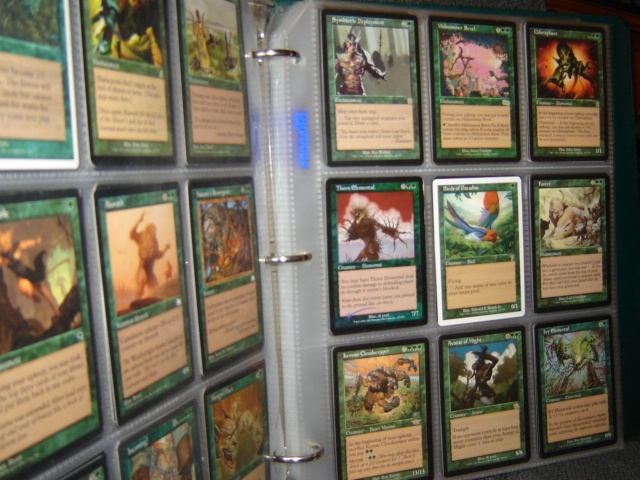
Binders work well for sets, team collections, and lower-consequence groups that collectors want to view in sequence. Side-loading pockets and a secure cover can reduce accidental exits, but the entire system still depends on page material, pocket size, card sleeves, binder construction, fill level, and storage position.
Avoid overfilling pages or rings. Cards near ring hardware can be damaged when pages turn or the binder closes, and heavy pages can pull against pockets. Test sleeved cards in the actual page, support the binder when moving it, and store it in the orientation recommended for its construction. A binder should make viewing controlled, not encourage repeated removal.
Boxes provide density and modular organization
Fitted boxes are usually the backbone of a growing collection. They support rows of sleeved cards, rigid holders, or slabs while allowing dividers, labels, and expansion. Choose internal dimensions for the completed holder, not the bare card, and check lid clearance, row width, divider thickness, and external shelf footprint.
Partly filled rows need support so cards do not slump. Fully loaded boxes need a safe lifting plan. Smaller modular boxes can be easier to move and replace than one large container. Keep boxes off floors and away from exterior walls, pipes, and places where a minor leak could reach them.
Evaluate materials and claims without relying on hype
Product labels often use preservation language without enough detail to compare products. A named material and measured specification are more useful than a broad “archival quality” claim. The U.S. National Archives identifies polyester, polypropylene, and polyethylene as examples of stable plastic enclosures for appropriate archival uses and warns against unsuitable plastics such as polyvinyl chloride. That institutional guidance does not certify a hobby product, but it explains why material disclosure deserves attention.
Ask what part of the product contacts the card. A safe outer shell does not answer questions about a soft insert, adhesive, printed divider, foam, or flexible page. Strong odor, oily residue, cloudiness, shedding fibers, rough edges, or uncertain material are reasons to pause and contact the seller or manufacturer.
Treat ultraviolet, water, and fire claims as limited test statements rather than absolute protection. What wavelength, duration, depth, temperature, or standard was tested? Does the claim apply to the holder, cabinet, or complete loaded system? Direct sun is still a poor display environment. A water-resistant case is not a flood plan. A rated safe still needs documentation, appropriate installation, and an access procedure.
Fit matters at every connection
A storage system has several interfaces, and each can fail. The card must fit the sleeve; the sleeve must fit the rigid holder; the holder and bag must fit the divider and box; the box must fit the shelf; the collector must be able to lift, identify, and retrieve it safely.
Measure unusual cards rather than guessing. Memorabilia, acetate, die-cut, embossed, booklet, oversized, and older cards may need specialized support. Thickness labels are useful starting points, not permission to push. If the card bows, the holder resists closure, corners approach a hard edge, or the card moves sharply when tilted, stop and reassess.
Compatibility can change between product generations. Save the manufacturer, model, stock code, dimensions, seller, order date, and a photograph of the package that passed testing. Before reordering, compare the current listing with that record. Marketplace reviews may combine variants, so confirm the selected size and quantity in the cart rather than relying on the main photograph.
Plan the room around the collection
Good enclosures cannot compensate for a persistently poor location. The Smithsonian Institution Archives and U.S. National Archives emphasize stable, moderate conditions and protection from light, water, pests, and damaging handling. For a home collector, consistency and risk reduction are more realistic goals than museum-level control.
Keep cards away from direct sunlight, radiators, hot attics, damp basements, exterior-wall condensation, and plumbing when possible. Use stable shelving that can carry the loaded weight. Raise the lowest level above the floor. Leave enough clearance to remove a box without scraping it or shifting another stack.
Monitor the room before buying expensive control equipment. A basic temperature and relative-humidity record across seasons can reveal patterns. Respond to the source of a problem—leaks, poor airflow, direct heat, or an unsuitable room—rather than assuming a sealed holder will isolate every card from it.
Household access belongs in the plan. Shelving should not tip, heavy boxes should not be overhead, and children or pets should not reach unstable displays. Security can begin with discreet location, doors, inventory, and access discipline before progressing to locked cabinets or safes.
Decide whether you need a safe
A card safe or secure cabinet is a system purchase, not a larger box. Define the group that requires restricted access and calculate its completed volume, including holders, boxes, space for retrieval, and future growth. Check internal usable dimensions rather than exterior size.
Review total weight, floor suitability, delivery route, stairs, anchoring, shelf ratings, lock type, backup access, ventilation, humidity monitoring, tested fire or water claims, warranty service, and removal. Ask an insurer how the collection should be documented and whether a particular installation affects coverage. Do not assume the cabinet's marketing language changes policy terms.
Access after a lock failure or household emergency matters. Keep keys, codes, inventory records, photographs, receipts, and recovery instructions appropriately separated. A secure cabinet that cannot be opened, serviced, or moved under realistic conditions creates a new concentration of risk.
Connect storage to grading and transport
Cards being considered for grading need a documented workflow, not a permanent waiting pile. Review condition under suitable light, record the decision, and use the grading company's current preparation and packing instructions before submission. The complete card grading guide explains condition and submission context, while the guide to buying grading services safely covers transaction checks.
Do not assume a display holder is a shipping holder. Transport adds drops, vibration, compression, temperature changes, and loss risk. Protect cards individually, prevent movement inside the outer container, keep an inventory, and choose insurance and signature options appropriate to the shipment. Test a travel case at normal loaded weight before taking important cards to a show.
For graded cards, verify every slab format you own. Cases from different companies and generations vary. A box advertised for slabs may fit one type tightly and leave another loose, or its lid may contact labels. Sample with low-consequence slabs before ordering a case quantity.
Test before buying in volume
Order the smallest quantity that can reveal both fit and manufacturing variation. Inspect the package, count the units, and check several examples in good light. Look for debris, rough seams, cracks, warping, cloudy areas, strong odor, incomplete closures, and dimensional inconsistency.
Use lower-consequence cards with the same size and construction as the intended group. Assemble every layer, label it, place it in the real box or binder, and perform ordinary retrieval several times. Partly load the container, carry it, put it on the assigned shelf, and check whether rows remain supported and lids close freely.
Complete this test while returns remain available. Keep packaging and photographs until the order is accepted. If the sample passes, record the exact specification and reorder that variant. If the listing changes, repeat verification rather than assuming a familiar product name guarantees continuity.
Build inventory and recovery into storage
Storage without an index can turn protection into friction. Give each container a stable identifier, then record the card's location in a spreadsheet, collection application, or database you can maintain. Labels should describe location without advertising sensitive contents to every visitor.
Photograph important cards and retain purchase records, grading identifiers, distinguishing features, and current locations. Back up the inventory somewhere separate from the collection. Decide who can access it if you are unavailable. These records support insurance discussions, theft reports, disaster recovery, estate planning, and ordinary collection management.
Create a simple response plan for water, smoke, pests, theft, and failed locks. Include who to contact, where clean temporary space is available, and which records are stored elsewhere. Do not improvise cleaning or separate wet, stuck material without appropriate conservation guidance; rushed handling can compound damage.
A practical buying checklist
Before checkout, confirm:
- the exact card formats, thicknesses, quantities, and jobs the product must support
- internal and external dimensions for every connected layer
- disclosed materials for surfaces that touch cards or enclosures
- closure, corner, seam, and opening design
- fit with sleeves, bags, dividers, boxes, binders, shelves, displays, or cases
- loaded weight and safe lifting or anchoring requirements
- room exposure to heat, humidity, light, water, pests, children, and pets
- seller identity, exact variant, included parts, shipping, returns, and replacement availability
- sample-test criteria and the date the return window closes
- labeling, inventory, backup, insurance, and emergency-access plans
The best sports card storage purchase is not necessarily the strongest-looking or most expensive product. It is the smallest compatible system that protects the defined card group, supports controlled handling, fits the real room, and can be maintained as the collection changes.
Conclusion
The best collecting decisions usually come from structure rather than urgency. When you combine clear comparisons, strong context, and a disciplined buying framework, you give yourself a better chance to build a collection with both enjoyment and staying power.