Answer-first summary
Charizard collecting expanded through successive releases that revisited older designs or introduced new identities, while auction publicity highlighted exceptional graded originals. These milestones document distinct collecting contexts; they do not establish a single price trajectory for all Charizard cards.
From one remembered card to several collecting markets
The Charizard market has evolved through overlapping layers: early Base Set collecting, later cards that revisit familiar designs, publicity around exceptional graded copies, and new releases with their own artwork and gameplay identity. The result is a broader field of choices, rather than one continuous price story for every card bearing the character.
That distinction matters when looking backward. An original printing, an anniversary remake, and a recent Charizard ex may appeal to the same person, but they represent different objects. A useful history asks what each period added to collecting and what evidence survives. It does not assume that a celebrated auction changed the value of every childhood binder.
The milestones below were reviewed on October 21, 2026. This is a selective history of products and market presentation, not a complete price index or a claim about the direction of prices today.
1999: the English Base Set becomes a historical reference
English Base Set Charizard provides a clear starting point for this account. PSA documents the 1999 issue and maintains a separate Shadowless Charizard record, with a linked entry for the 1st Edition card. These distinctions show why even the phrase “original Charizard” needs qualification.
For historical collecting, the important change in perspective is from identifying a character to identifying an edition. The artwork can remain familiar while printing, language, and condition define the actual object. A buyer reconstructing a childhood collection may want a worn copy of the remembered design. Another may want a specific early printing. Those goals belong in different comparisons.
This also limits retrospective price claims. A remembered shop price without a date, condition description, or edition is weak evidence. A documented sale of a particular copy is stronger, but still represents that copy. The historical appeal of the early card should not become an excuse to erase its variations.
2016: familiar design returns in a later product
Pokémon's official discussion of XY—Evolutions describes its return to the visual style of Base Set. For collectors, this provides a useful milestone: the appearance of an older card could be revisited in a new release without making the new card an original printing.
The collecting implication is a distinction between attachment to an image and attachment to its first issue. Someone may enjoy a later interpretation because the design is familiar. Someone else may care specifically about release history. Neither preference needs a forecast about future value to make sense.
When reviewing a collection assembled across these periods, check the set and card number rather than sorting solely by illustration. Place original and later versions side by side, with their release identities recorded. That preserves the story of how a design was revisited while preventing a visually persuasive but historically incorrect substitution.
2020–2021: auction publicity highlights grade and edition
A Heritage Auctions announcement dated December 30, 2020 promoted a 1999 1st Edition Charizard graded PSA 10 for a January auction. Its published estimate was $350,000 or more. This is evidence of how an exceptional copy was marketed at that moment; the estimate is not a completed sale or a current valuation.
The useful historical lesson is how tightly that publicity attached to a defined object: a particular edition in a particular grade. Remove those details and the story becomes misleading. A headline about an exceptional copy cannot establish the price of an Unlimited example, an ungraded card with a crease, or a recent release.
An auction house also has a commercial reason to attract attention. Its announcement can establish what it offered and how it presented the lot, but cannot independently measure the whole market. To study actual price change, pair dated sale records for matching cards and inspect the terms. Do not build a return calculation by joining an old estimate to a newer asking price.
2021: Celebrations makes historical reference explicit
The Pokémon Company's June 2021 Celebrations announcement identified Base Set Charizard among the classic cards being remade for the brand's 25th anniversary. It scheduled the expansion's rollout from October 8, 2021. Here, revisiting the past was an explicit part of the product concept.
This created a different collecting proposition from acquiring an early printing. An anniversary card can commemorate the older design while remaining an identifiable product of its own year. For a collector building a visual history, owning both can illustrate continuity. For someone pursuing original editions, the anniversary version does not complete the same checklist.
Do not infer original-card price changes from the announcement alone. A product release documents another collecting option, not how many buyers switched between versions or what they paid. Claims of renewed attention may be plausible, but their size and price effect need transaction evidence beyond the existence of the release.
2023: a newer Charizard can have a different identity
The official Obsidian Flames expansion page features a Darkness-type Tera Charizard ex. It offers another useful historical contrast: Charizard collecting can follow a new treatment of the character, rather than only returning to the early Base Set image.
A collector may organize these cards by illustration, game mechanic, language, or release series. A player may care about the card's game function. Those interests can overlap, but should not be treated as one demand pool. A new design does not automatically inherit the scarcity, condition profile, or buyer expectations of an early holographic card.
When examining modern releases historically, separate release identity from later market performance. An official product page establishes what was presented; it does not establish print quantity, pull rates, long-term popularity, or resale ease. Those claims require their own evidence. Leaving an unknown unresolved is more useful than filling a timeline with unsupported numbers.
What this sequence changes for collectors
Across these milestones, the name “Charizard collection” can describe several projects: an early-printing collection, a history of a familiar illustration, a sequence of anniversary products, or a selection of newer interpretations. That is an editorial reading of the documented releases, not a measured ranking of their popularity.
Use Pikachu as a reference when thinking about collecting one character across changing designs. Use Blastoise when thinking about completing a coordinated Base Set group. Base Set Charizard remains the historical reference in this article, but the alternatives help identify your goal. They are not substitutes in a price chart.
Write a collection brief before adding another era. State whether release history, visual continuity, condition, or gameplay matters most. This makes the next purchase easier to explain and reduces the temptation to buy an unrelated card just because a headline uses the same character name.
How to investigate price evolution honestly
Product history and price history answer different questions. To study price evolution, choose one exact card and keep language, printing, grading company, and grade constant where possible. Record dated transactions, currency, fees, and the condition visible in photographs. A chart that silently changes the card being measured cannot demonstrate a meaningful trend.
Even a consistent grade may include differences in eye appeal. Check whether repeated appearances are the same certified copy, and whether the reported figure includes a buyer's premium. A small set of exceptional auctions cannot establish the typical outcome for ordinary examples. State the sample's limitations before drawing conclusions.
Avoid presenting an old grading population as a permanent surviving supply. Counts can change as cards are submitted and records are updated. Similarly, present-day availability cannot be read directly from a historical product announcement. Archive the observation date with each figure so later readers know what was actually observed.
Keep a second column for evidence type: product announcement, pre-sale estimate, completed sale, or personal recollection. This prevents a timeline from giving every entry equal authority. An announcement can date a release, while a receipt can document your own transaction; neither automatically describes the entire market. If an archive no longer shows images or sale terms, mark that gap instead of borrowing details from a different listing. A shorter history with traceable records is easier to update than a dramatic sequence whose numbers cannot be reconstructed.
The complete Charizard collector guide provides broader collecting context. The safe-buying guide covers checks for a specific purchase. Use this timeline to understand why cards from different periods belong in separate research groups before applying those buying checks.
Reading the market in 2026
As of this review, the defensible conclusion from these sources is that Charizard has appeared in distinct collecting contexts across multiple eras. The evidence here does not establish a market-wide rise, decline, recovery, or current best purchase. Such claims would need a defined basket of cards and a transparent set of current transactions.
For an existing collection, inventory the exact releases you own and preserve receipts, photographs, and condition notes. For a new collection, choose which historical story you want to tell. You can appreciate the early artwork, an anniversary remake, or a modern treatment without assuming they must move together financially.
The most useful consequence of knowing the history is better classification. It lets you recognize what an item represents, ask for the right evidence, and avoid confusing a famous name with a specific collectible.
Method and limitations
We selected documented product milestones and an auction announcement to examine collector attention and pricing context over time. Market signals are treated as context rather than predictions. This page is educational and does not provide financial advice. Sources were checked for the stated milestones; no comprehensive transaction series, current price target, print-run estimate, or population total is asserted.
Image credit
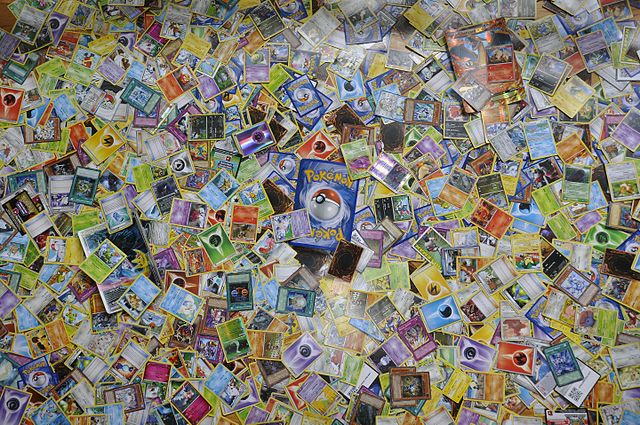
Photograph: Trading cards vending machine by OhanaUnited, unchanged under Creative Commons Attribution-ShareAlike 4.0. The Singapore vending machine shows Pokémon and One Piece packs as context for the wider card market, not any individual historical Charizard card discussed here.
Conclusion
The best collecting decisions usually come from structure rather than urgency. When you combine clear comparisons, strong context, and a disciplined buying framework, you give yourself a better chance to build a collection with both enjoyment and staying power.